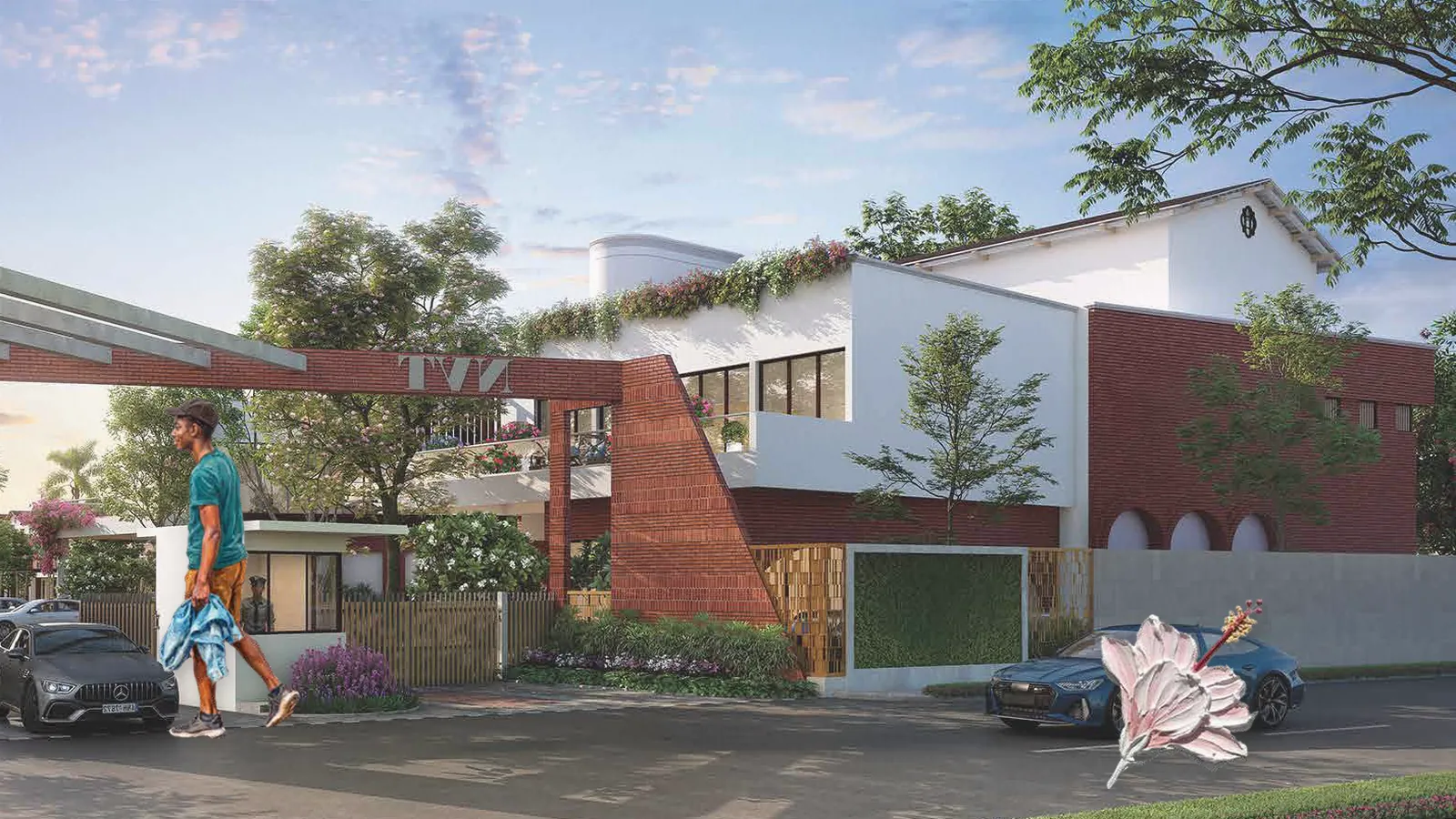
A gate on its own is not a community. What turns a fenced layout into a good place to live is the quiet machinery behind it: who maintains the roads, who holds the money, and what happens in year eight when the developer has long moved on. This guide to gated community villas in Bangalore focuses on that machinery, because it is what the premium villa market rarely explains in brochures.
What "gated" really covers
A gated villa community has a single controlled entry, internal roads owned by the layout, and shared amenities. Beyond that, the term varies from a security booth on an open plot to a fully managed township with staffed gatehouses and visitor logging.
Look for these concrete features: an entry gateway with a security kiosk, visitor parking outside the residential area, CCTV coverage at gates and along perimeters, a clear wall or fence line, and a plan for night-time patrol. Whispering Hues, for instance, plans an arrival plaza and an entry gateway with a security kiosk and visitor parking, which is the right structure; what you should ask is how it will be staffed and by whom.
Who owns the roads and common areas
Common areas should be legally transferred to the residents' association or maintained under a registered arrangement. If the developer retains title indefinitely, residents may have little say over changes.
Ask these questions in writing:
- Are internal roads, parks, clubhouse and utilities part of the common-area share assigned to each villa?
- At what point, and under what trigger, does management pass from developer to association?
- Is there a registered declaration or deed of covenants setting rules on construction changes, painting, signage and parking?
Maintenance, corpus and sinking funds
Maintenance covers recurring costs; the corpus deposit covers future repairs and is meant to be held for the community. Understand both before you sign.
On the September 2026 Whispering Hues price sheet, advance maintenance for one year is quoted at ₹55 per sq ft of built-up area, with a corpus deposit also at ₹55 per sq ft, plus a ₹10 lakh recreation membership. For a 3,750 sq ft villa, that makes both items about ₹2.06 lakh each by simple multiplication. Use our maintenance charges guide to benchmark any quote, and ask where the corpus is held and who can withdraw from it.
| Fund | Purpose | Question to ask |
|---|---|---|
| Monthly maintenance | Security, housekeeping, landscaping, utilities | Is it charged per sq ft of BUA or flat per villa? |
| Corpus deposit | Long-term repairs and replacement | In whose name is the account? |
| Club membership | Access to clubhouse | Is it refundable or transferable on resale? |
| Sinking fund | Major renewals | Is there a published schedule? |
Rules that protect your investment
Good communities regulate what residents can do to their own houses. That can feel restrictive but keeps property values aligned. Typical rules cover elevation changes, additional floors, rooftop structures, signage, commercial use and pets in shared spaces.
Pet policy matters more than most buyers expect. Whispering Hues's private backyards give pets space at home, but a community pet policy has not been published, so ask for it in writing for any project you shortlist.
Staying safe, practically
The best security is boring: staffed gates, visitor verification, a service-staff pass system and an incident log. Ask how domestic workers, delivery partners and contractors are admitted, and whether the gate system integrates with an app. See the advantages of living in a gated villa community for the lifestyle side of this argument.
Gated versus standalone
A standalone independent house gives you freedom at the cost of managing everything yourself; a gated villa trades some freedom for shared infrastructure. The detailed comparison is in villa versus independent house in Bangalore. Density affects both, which is why low-density villa projects deserve a look.
Due diligence summary
- RERA registration and the promoter's name, on rera.karnataka.gov.in
- Sanctioned layout plan and approvals
- Draft sale agreement and construction agreement
- Draft association bye-laws or deed of covenants
- Written maintenance estimate and what it covers
Book a site visit to see a planned gated layout or message +91 80509 73051 for the current EOI terms.